.svg)
.svg)

.svg)
The 12 Best Data Enrichment Tools for Scalable Growth in 2026

Stale data is a liability. It leads to missed opportunities for sales teams, flawed strategies for product managers, and wasted resources for recruiters. Data enrichment, the process of enhancing raw data with contextual information, is the critical solution. It powers intelligent sales outreach, targeted marketing, and efficient recruiting operations. However, the quality and freshness of that data are paramount. The difference between batch-updated, cached information and live, real-time intelligence can determine the success of your next campaign, product feature, or AI agent.
This guide cuts through the noise to evaluate the best data enrichment tools available today. We focus on what truly matters for modern tech stacks: data freshness, API quality, and practical application. Whether you're a product manager building an AI SDR, a RevOps leader integrating webhooks, or a founder scaling an outbound agency, this resource is for you. We provide a comprehensive, side-by-side comparison to help you find the right platform for your specific needs.
You won't find generic feature lists here. Instead, we dive deep into how each tool performs in the real world. We'll explore how product, sales, and recruiting teams can leverage these platforms to build smarter, faster, and more effective operations. Each entry includes detailed analysis, screenshots, direct links, and practical examples to illustrate its impact. Our goal is to equip you with the insights needed to select the best data enrichment tool and immediately put it to work.
1. Limadata
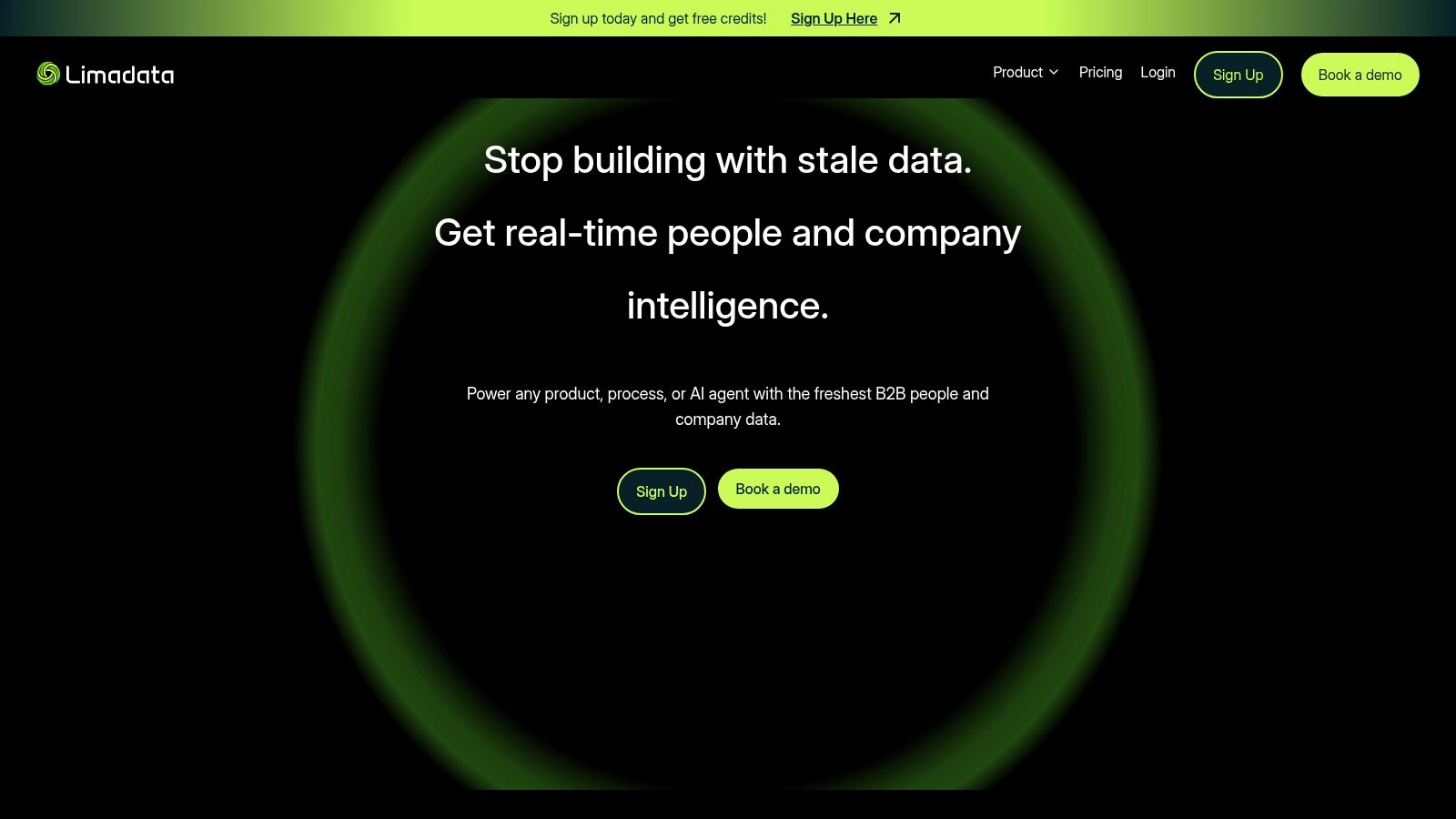
Limadata earns its top position by fundamentally changing the data enrichment paradigm. Instead of relying on vast, often-stale databases, Limadata operates as a real-time data engine, querying multiple trusted sources on demand. This "live" approach ensures that product and engineering teams receive the freshest, most actionable B2B intelligence available, making it one of the best data enrichment tools for applications where data accuracy is non-negotiable.
The platform is engineered for developers and technical teams who require production-grade reliability and flexibility. Its comprehensive API suite covers the full spectrum of B2B data needs, from deep person and company enrichment to contact discovery and even programmatic web research, making it a versatile foundation for any data-driven product or workflow.
Core Strengths & Use Cases
Limadata's architecture is built for modern, event-driven applications. Its RESTful endpoints, detailed OpenAPI documentation, and high-performance infrastructure make integration seamless.
- Real-Time Data Delivery: The key differentiator is its live-query model. For example, a product team building an AI-powered sales agent can query Limadata the moment a prospect interacts with their site. The agent gets the prospect's most recent job title and company funding status in milliseconds, allowing it to generate a message like, "Congrats on the new VP role and the Series B funding!"—a level of relevance impossible with cached data.
- Developer-First Features: Limadata offers more than just data points. With tools like batch processing for large-scale enrichment and webhook-based "Watch" alerts, a recruiting platform can be instantly notified when a top candidate on their list changes jobs. Practically, a webhook can trigger a Slack alert to the recruiter saying, "Jane Doe just updated her LinkedIn profile to 'Senior Director' at Competitor Inc.," enabling immediate outreach.
- Comprehensive Enrichment Suite: The API covers everything from standard firmographics (headcount, tech stack) and person attributes (work history, skills) to advanced capabilities like reverse email enrichment and content extraction from web pages, which is ideal for RAG pipelines.
Key Takeaway: Limadata is an exceptional choice for those building data-intensive products or automated workflows. Its real-time data sourcing and developer-centric tools provide a powerful and reliable foundation that legacy, static database providers cannot match.
Pricing & Practical Considerations
Limadata offers a flexible, credit-based pricing model that allows users to scale. A free trial with starter credits is available for testing. From there, plans include Starter ($50/month for ~1,500 credits), Pro ($200/month for ~10,000 credits), and custom Enterprise tiers with pay-as-you-go options.
- Data Freshness: Live data sourcing minimizes the risk of acting on outdated information.
- API Quality: Production-ready, well-documented APIs with advanced features like webhooks.
- High Accuracy: Strong coverage for verified work emails and mobile numbers.
- Flexibility: Scalable pricing and a try-before-you-buy model.
- Cost Predictability: Credit-based systems can be challenging to budget for at scale. It is crucial to test endpoint credit consumption before committing to a large-scale deployment.
- Compliance: As with any tool providing personal contact data, users are responsible for ensuring their use case complies with all relevant privacy regulations (like GDPR or CCPA).
Website: https://limadata.com
2. Clearbit (Breeze Intelligence within HubSpot)
Clearbit has long been a major player in B2B data enrichment, focusing on providing real-time firmographic and technographic data directly into sales and marketing workflows. Following its acquisition by HubSpot, its capabilities are now being integrated as "Breeze Intelligence," making it a powerful, native option for teams already embedded in the HubSpot ecosystem. The platform excels at automating CRM data hygiene and powering dynamic lead scoring and routing.
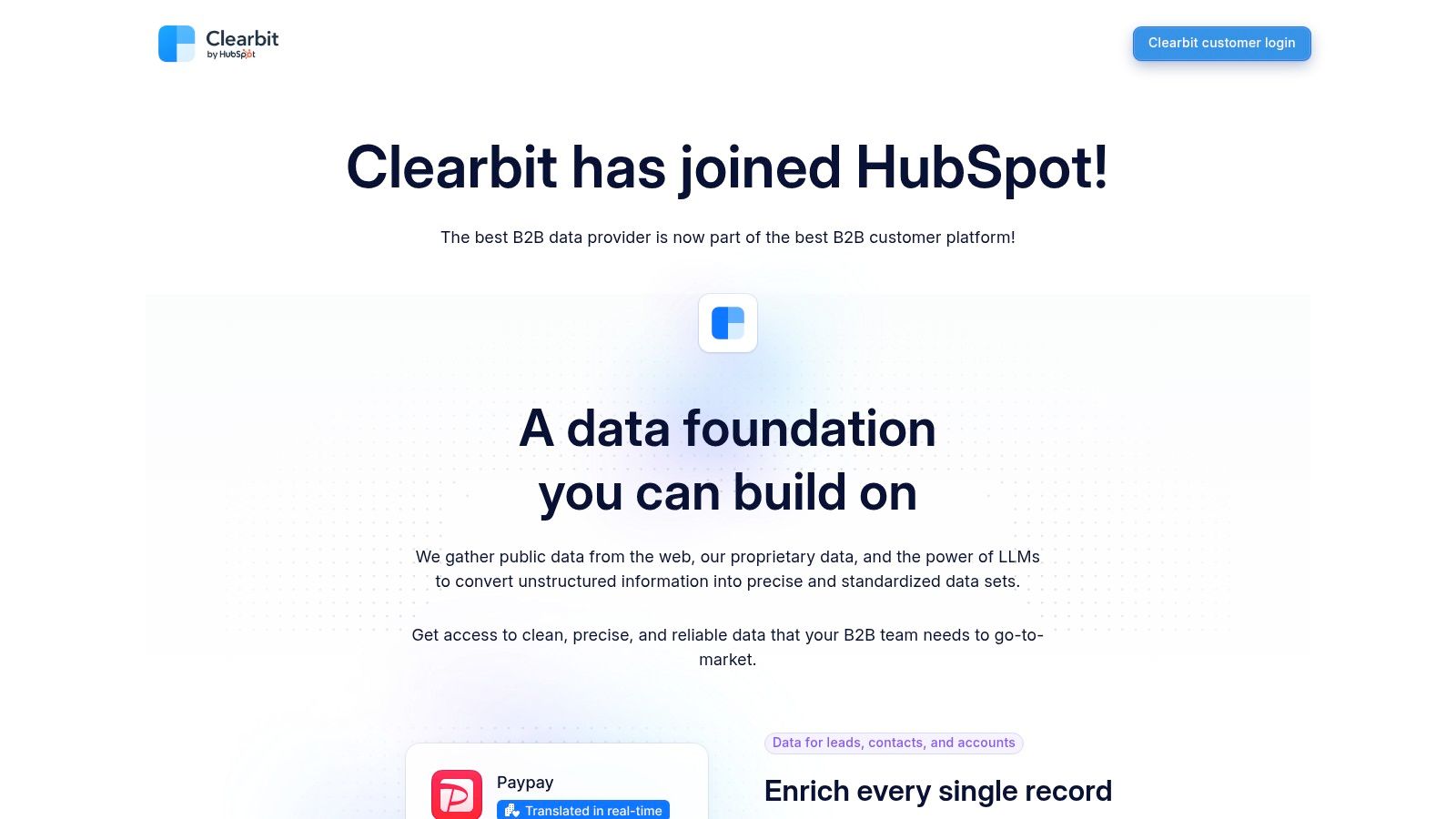
Its core strength lies in its deep, native integrations with platforms like Salesforce and, of course, HubSpot. This allows for seamless, automated data refreshes whenever a change in a contact's or company's profile is detected. For a practical example, a marketing operations manager can set up a HubSpot workflow that uses Clearbit to enrich a new form submission. If the form filler's company has over 500 employees and uses Salesforce (data provided by Clearbit), the lead is automatically assigned a high score, routed to the enterprise sales team, and the team receives an instant Slack notification. Product teams often use Clearbit's Reveal API to de-anonymize website traffic, personalizing the user experience for visitors from target accounts.
Evaluation
- Data Freshness & Quality: ★★★★☆ (4/5)
- Clearbit draws from over 250 public and private sources, offering strong B2B firmographic data. Its automatic refresh feature helps maintain data hygiene within a CRM, though it relies on scheduled syncs rather than true, event-driven updates. For teams needing instant notifications on data changes, they might explore solutions with more advanced alert systems. You can learn more about using webhooks for real-time data updates.
- Pricing is not public and requires engaging with their sales team. Since the HubSpot acquisition, access is increasingly tied to HubSpot subscription tiers, and many of its popular free tools were sunset in April 2025, creating a higher barrier to entry for smaller teams.
ProsConsMature, well-documented API and integrationsOpaque, sales-led pricing modelStrong automation for lead scoring and routingCapabilities are now heavily intertwined with HubSpot's ecosystemReal-time form enrichment to reduce frictionSunsetting of free tools limits accessibility for smaller projectsAutomatic CRM record updates keep data currentLess focus on developer-first features like advanced webhooks
Website: https://clearbit.com/
3. ZoomInfo Enrich
ZoomInfo has built a reputation as an enterprise-grade B2B intelligence powerhouse, and its Enrich product delivers on that promise. It provides deep firmographic and contact data across more than 200 fields, making it a go-to for large sales and marketing organizations that require extensive coverage and accuracy, particularly for direct-dial phone numbers and verified email addresses. The platform is designed for large-scale, ongoing CRM and marketing automation system hygiene.
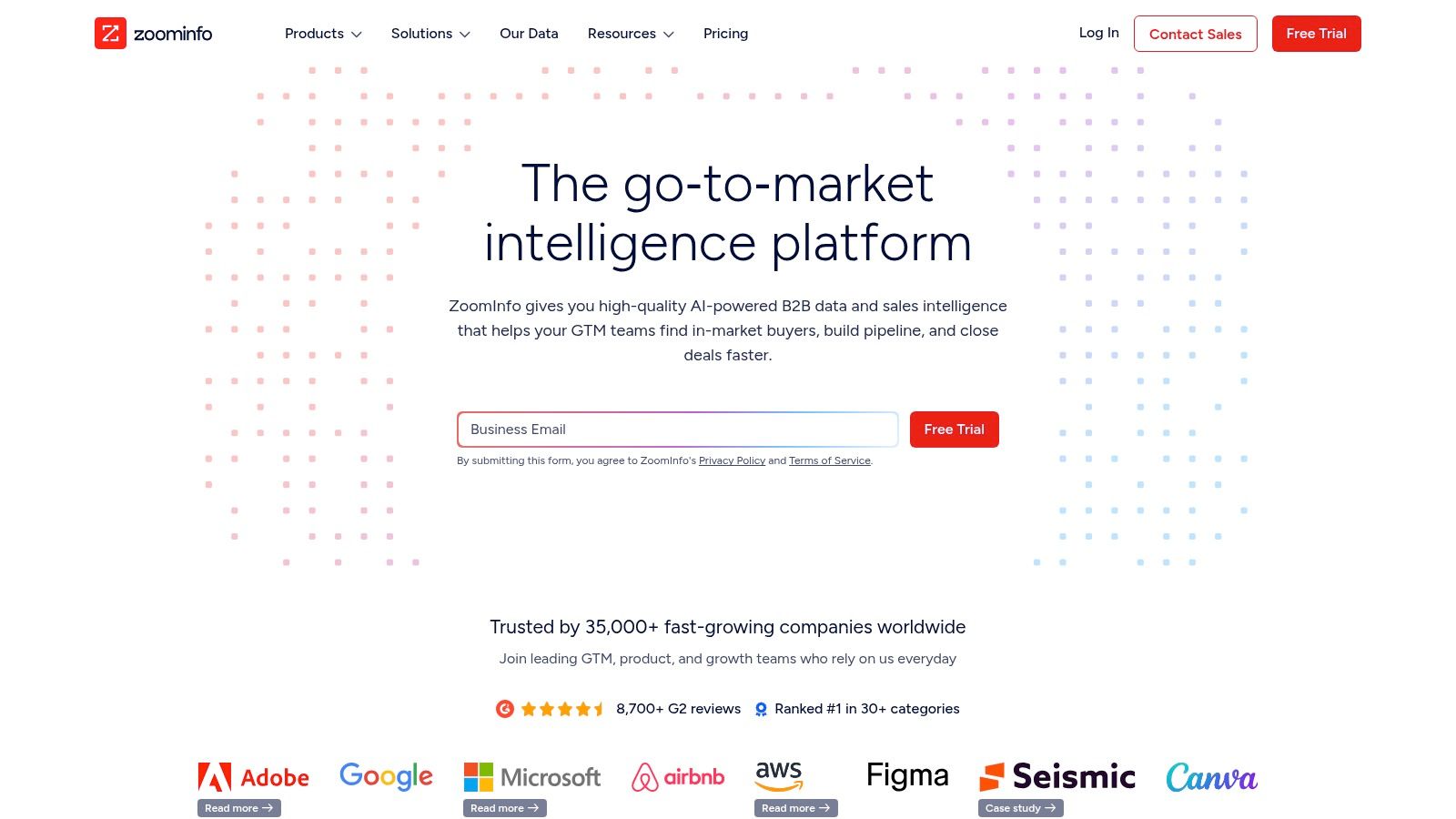
Its core advantage is the sheer breadth and depth of its proprietary dataset, which includes advanced intent signals to identify companies actively researching solutions. A practical use case is a sales operations team scheduling a weekly ZoomInfo enrichment job on all new leads in Salesforce. The job automatically fills in missing direct-dial phone numbers, job titles, and company revenue. Simultaneously, it flags any leads from companies showing "intent" for keywords like "cybersecurity solutions," pushing those leads to the top of the SDR's call queue for immediate follow-up.
Evaluation
- Data Freshness & Quality: ★★★★☆ (4/5)
- ZoomInfo's strength lies in its vast, human-verified B2B contact and company dataset, offering high accuracy for emails and direct-dial phone numbers. Data is updated frequently, but the standard enrichment process is often schedule-based rather than real-time, which may not suit use cases needing instant data on new signups.
- Pricing is at the enterprise level, often sold in large, annual packages based on credits and user seats. This model can be cost-prohibitive for startups or teams needing more flexible, pay-as-you-go access, creating a significant barrier to entry for smaller-scale projects.
ProsConsVery large B2B dataset with strong direct-dial coveragePremium, credit-based pricing can be expensive at scaleExtensive intent data signals for timely outreachSome users report field-mapping/overwrite quirks with CRMsBroad ecosystem of native CRM/MA integrationsLess focus on developer-first, real-time API use casesMultiple data delivery options, including for data warehousesThe platform's complexity can require a dedicated administrator
Website: https://www.zoominfo.com/
4. Apollo.io (Data Enrichment)
Apollo.io is widely recognized as an all-in-one sales intelligence platform, but its data enrichment capabilities are a core component of its offering. It allows teams to enrich contact and company records directly within their CRM, through bulk CSV uploads, or programmatically via its API. This makes it a strong contender for sales and marketing teams who want a unified stack for prospecting, engagement, and data hygiene, eliminating the need for separate tools.
The platform’s strength lies in its integrated nature. For instance, a growth marketing manager can export a list of 5,000 leads from a recent webinar as a CSV file. They upload this file to Apollo, which enriches it with job titles, company sizes, and verified email addresses within minutes. They can then re-import the clean list into their marketing automation tool and, using the new data, segment the audience into three distinct email nurture campaigns: one for SMBs, one for mid-market, and one for enterprise leads, all without leaving the Apollo ecosystem for data cleaning.
Evaluation
- Data Freshness & Quality: ★★★☆☆ (3/5)
- Apollo leverages a massive B2B database of over 270 million contacts, which is continuously updated. While the data quality is strong for sales prospecting, particularly for contact information, its firmographic data is not as deep or real-time as more specialized providers. Enrichment is primarily based on what exists in their database at the time of the request.
- Apollo offers a transparent, multi-tiered pricing model, including a generous free plan that provides a limited number of enrichment credits. This makes it highly accessible for small teams or those wanting to test the service. However, enrichment consumes credits, and higher-volume needs will require upgrading to paid plans.
ProsConsAll-in-one platform for prospecting, enrichment, and engagementEnrichment quality is tied to the existing Apollo databaseTransparent pricing with a functional free tierConsumes credits which are also used for other platform featuresSimple and effective CSV upload for bulk enrichmentAdvanced API features and higher limits require more expensive plansSeamless integration with major CRMs like Salesforce and HubSpotLess focused on deep, real-time firmographic or technographic data
Website: https://www.apollo.io/product/data-enrichment
5. Lusha
Lusha is a well-known B2B contact and company data provider, distinguished by its user-friendly browser extension and a straightforward, credit-based model. It excels at providing direct-dial phone numbers and verified work emails, making it a favorite among sales and recruiting teams who need quick, actionable contact information directly from social profiles or company websites. Its accessibility, with a free trial offering credits to new users, makes it one of the easiest data enrichment tools to test and implement.
The platform is built for speed and ease of use. A perfect example is a recruiter sourcing candidates on LinkedIn. They find a promising profile for a "Senior Software Engineer" role but have no contact information. They click the Lusha browser extension, and in a pop-up window, Lusha reveals a personal email address and a direct-dial mobile number. The recruiter can now bypass InMail and reach out to the candidate directly, significantly speeding up the hiring process. This simple yet effective approach helps teams quickly build targeted call and email lists.
Evaluation
- Data Freshness & Quality: ★★★☆☆ (3/5)
- Lusha maintains a large, crowd-sourced database, which helps it provide a high volume of mobile numbers. However, data accuracy can vary, and its company-level data is less comprehensive than some enterprise-focused competitors. The platform relies on its community and verification algorithms to maintain data quality.
- Lusha offers transparent, credit-based pricing with plans suitable for individuals, small teams, and enterprises. The free plan provides starter credits, offering a no-cost way to evaluate its data. While the model is easy to understand, high-volume API usage or phone number enrichment can consume credits quickly, requiring a higher-tier plan.
ProsConsEasy to start with a free trial and simple credit-based modelData accuracy can be inconsistent, particularly for niche rolesExcellent for finding direct-dial and mobile phone numbersAPI has a minimum charge per call, which can be costly at scaleUser-friendly browser extension for on-the-fly enrichmentCompany data is less detailed compared to other enrichment toolsClear and transparent pricing tiers for different team sizesLower-tier plans may have limits on features like list exporting
Website: https://www.lusha.com/
6. People Data Labs (PDL)
People Data Labs (PDL) positions itself as a developer-first data partner, providing granular person and company data enrichment through a suite of flexible APIs. It’s built for technical teams that require programmatic access and scalable data operations, moving beyond simple CRM plug-ins. The platform is particularly strong for engineering and product teams building proprietary systems, such as recruiting tech or AI-powered sales tools, that rely on high-quality, on-demand data.
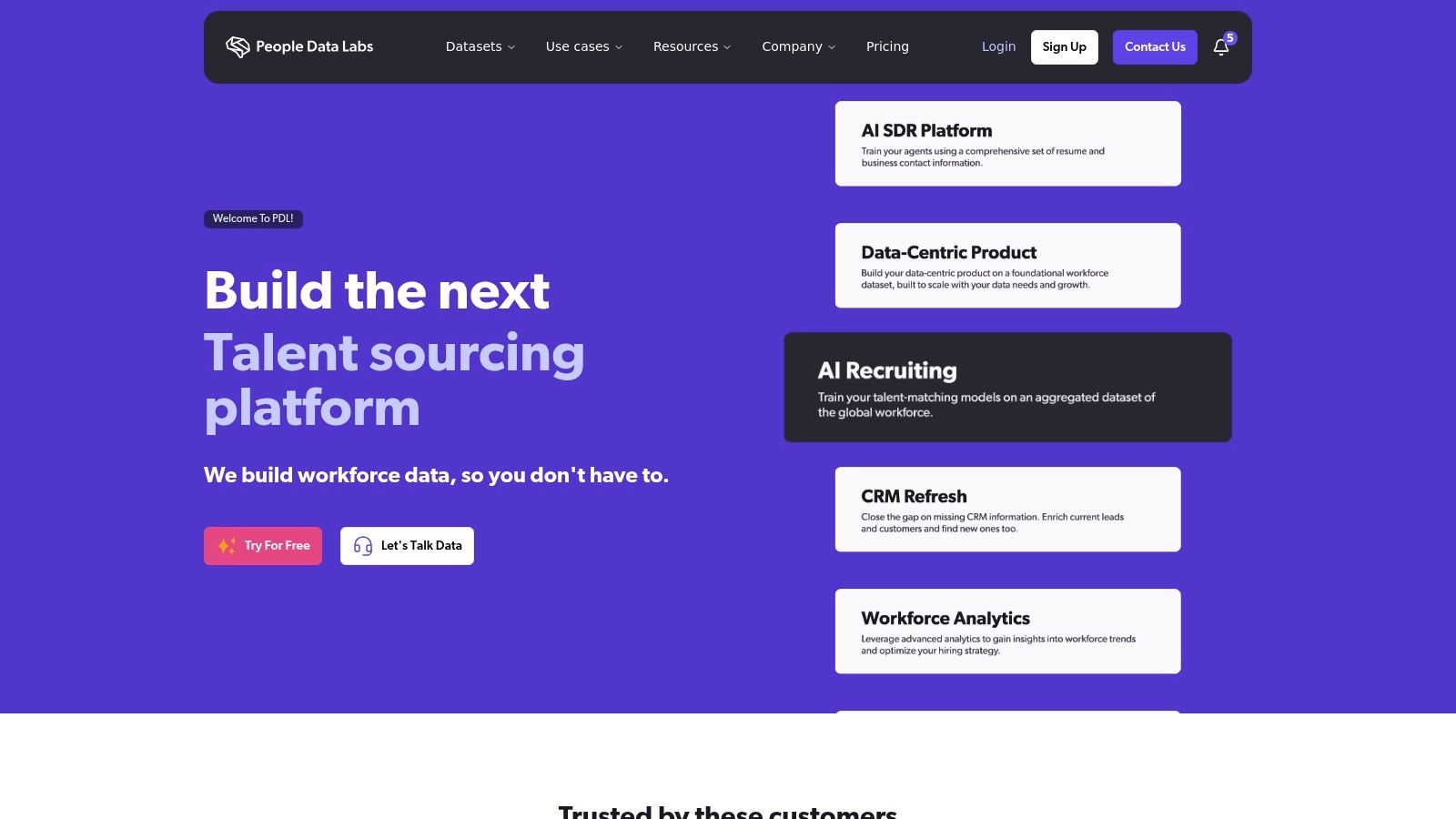
Its core value lies in its transparent, credit-based pricing and robust developer tooling, including an API Explorer and cleaner APIs for data normalization. For example, a development team building a candidate sourcing platform can use PDL’s Person Search API to find engineers with "5+ years of Python experience" who have previously worked at "FAANG companies." Once they have a list of profiles, they use the Person Enrichment API to pull full work histories, skills, and education from just a LinkedIn profile URL, populating their native platform with rich, structured data for recruiters to search.
Evaluation
- Data Freshness & Quality: ★★★☆☆ (3/5)
- PDL aggregates data from thousands of sources, offering extensive person and company profiles. However, the data is primarily suited for B2B use cases and may have less coverage for B2C contexts. The freshness depends on its data acquisition and verification cycles, which means it serves better as a foundational dataset rather than a source for real-time event triggers like job changes.
- PDL offers public, granular, and credit-based pricing, which is a significant advantage for teams wanting to predict costs and scale without engaging in a lengthy sales process. Its self-serve tiers are accessible, though high-volume usage often necessitates a move to a more comprehensive enterprise plan.
ProsConsTransparent, credit-based pricing with public tiersRequires technical implementation; not an out-of-the-box solutionStrong documentation, API Explorer, and developer-centric toolingSelf-serve API rate limits may be restrictive for high-volume needsBulk enrichment endpoints are ideal for large-scale data projectsData is more static, less focused on real-time event updatesGranular control over the data points requestedLess emphasis on native CRM integrations compared to competitors
Website: https://www.peopledatalabs.com/
7. Dun & Bradstreet (D&B Connect / D&B enrichment)
Dun & Bradstreet is a legacy institution in the B2B data world, offering enterprise-grade company identity resolution anchored to its proprietary D‑U‑N‑S Number. This unique identifier allows organizations to create a single source of truth for their customer and supplier data, making D&B a cornerstone for master data management (MDM) and complex de-duplication projects. Its strength lies in mapping intricate corporate family trees and providing risk and compliance-oriented attributes that are critical for large-scale operations.
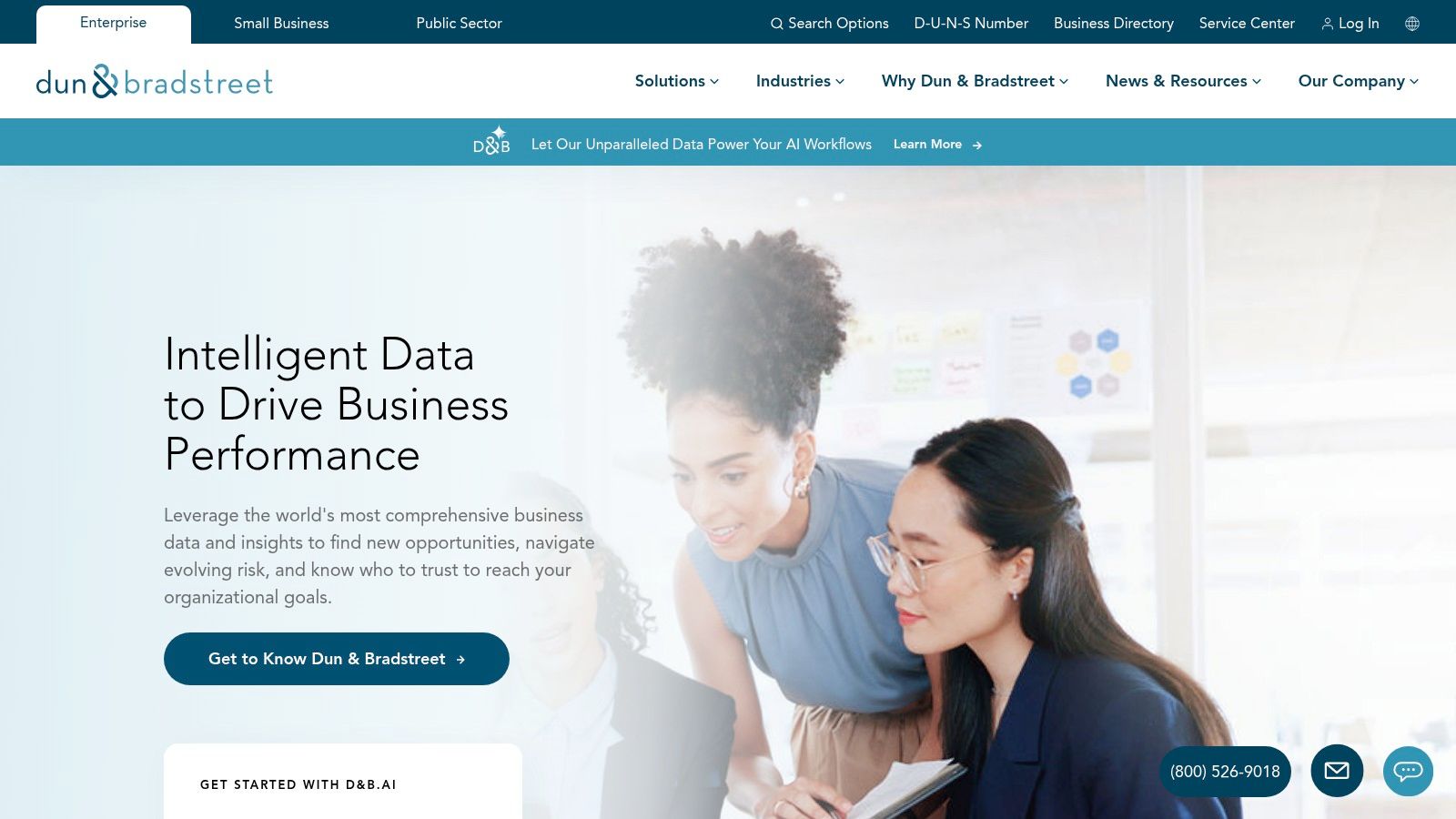
The platform is designed for deep enterprise integration rather than quick, self-serve use cases. A common scenario involves a global manufacturing company that has dozens of CRM instances from various acquisitions. They use D&B to match all company records against the D‑U‑N‑S database. This reveals that "ACME Corp," "Acme Inc.," and "ACME Solutions GmbH" are all subsidiaries of the same parent company. This allows them to consolidate these records, understand their total business relationship with the parent company, and prevent multiple sales teams from calling on the same account.
Evaluation
- Data Freshness & Quality: ★★★★☆ (4/5)
- D&B's data is widely regarded as a global standard for business identity, especially for corporate hierarchies and official firmographics. Its quality is foundational for compliance and risk assessment. However, the data update frequency can be slower than real-time-focused providers, with delivery often managed through batch processes or scheduled API calls rather than instant, event-driven webhooks.
- Access to D&B's data is exclusively enterprise-focused and requires a direct sales engagement. Pricing is opaque, complex, and tailored to large-scale deployments, making it inaccessible and cost-prohibitive for SMBs, startups, or teams needing a straightforward, pay-as-you-go model.
ProsConsWidely recognized business identity key for enterprise linkingPricing and packaging are sales-led and enterprise-focusedRich corporate family trees and compliance-oriented attributesSetup and licensing can be more complex than with SMB toolsStrong foundation for MDM and de-duplication projectsLess suited for high-velocity, real-time sales/marketing use casesExtensive firmographic data and specialized "Data Blocks"API is not designed for simple, self-serve developer access
Website: https://www.dnb.com/
8. Cognism
Cognism positions itself as a premium B2B intelligence platform with a strong emphasis on providing high-quality, phone-verified mobile numbers. Its core offering, "Diamond Data," is human-verified, making it a go-to choice for sales teams that rely heavily on cold calling and need to maximize connection rates. The platform combines contact and company enrichment with buyer intent signals, helping revenue teams identify and engage in-market accounts at the right time.
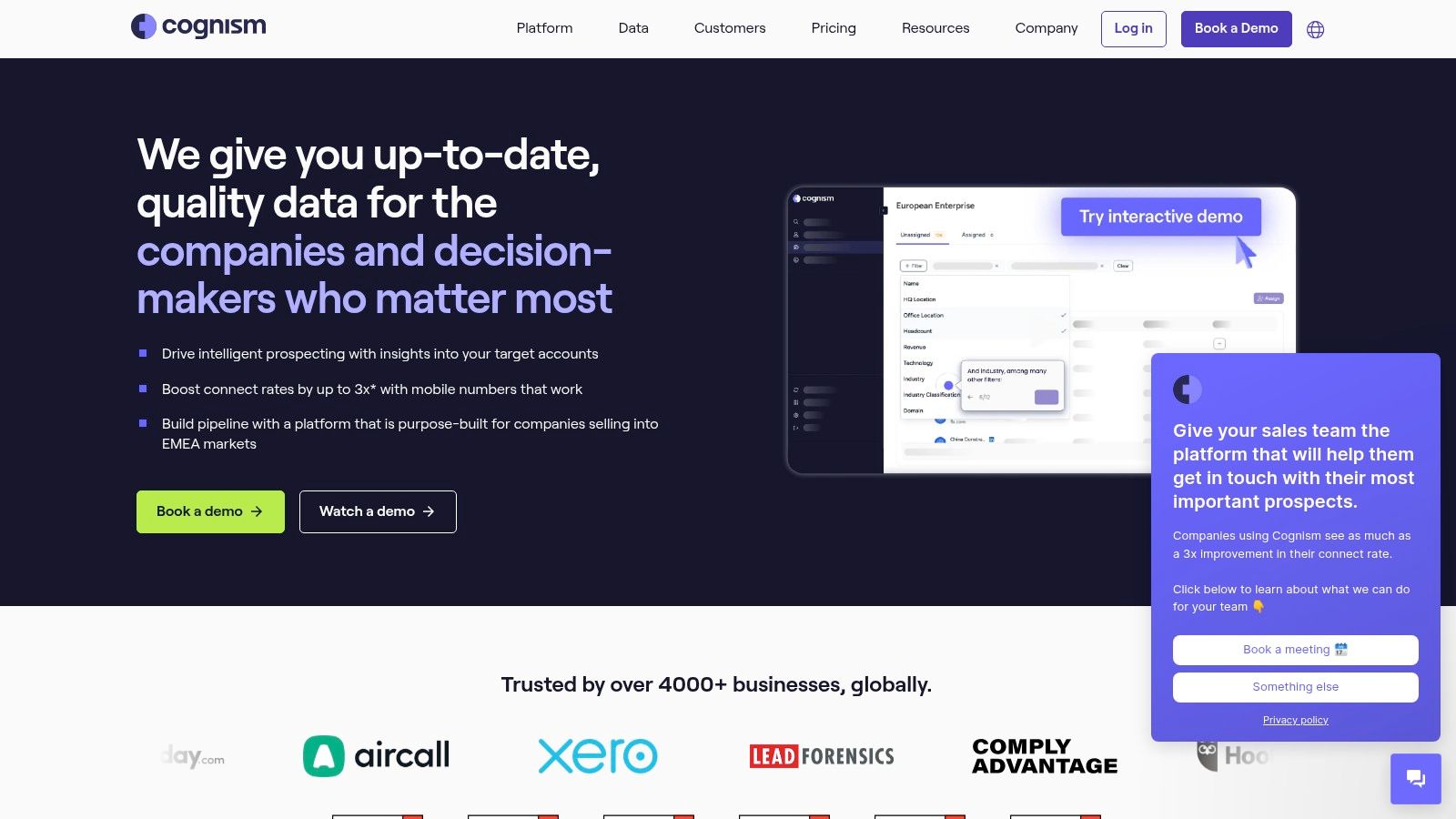
The platform is designed for growth-oriented teams looking to improve outbound efficiency. For example, an account executive uses Cognism to create a list of VPs of Marketing at SaaS companies in the UK. The platform not only provides their contact information but also flags three companies that are showing high "intent" on topics related to "lead generation." The AE prioritizes these three accounts, uses the "Diamond Data" verified mobile number to call the VP, and opens with, "I saw your company has been researching new lead generation strategies, which is why I'm calling..." This timely and targeted approach drastically increases the chances of booking a meeting.
Evaluation
- Data Freshness & Quality: ★★★★☆ (4/5)
- Cognism’s key differentiator is its human-verified "Diamond Data," which offers exceptional accuracy for mobile numbers. Overall data quality is high, though like any provider, coverage can vary by region and industry. Their focus is less on real-time API-driven updates and more on providing a highly accurate static dataset for outbound campaigns.
- Pricing is not public and is based on customized packages tailored to team size and feature requirements. This sales-led approach typically places it at a higher price point, making it more suitable for established sales teams rather than startups or small businesses needing a flexible, pay-as-you-go option.
ProsConsHigh accuracy on phone-verified mobile numbers (Diamond Data)Opaque, enterprise-focused pricing modelStrong B2B intent data to identify in-market buyersLess focus on developer-first features like real-time webhooksSeamless integrations with popular CRMs and sales toolsIntent signals and advanced features are often in higher-tier plansGood coverage for European marketsMay be cost-prohibitive for smaller teams or lean startups
Website: https://www.cognism.com/
9. Experian Data Quality – Data Enrichment
Experian brings its enterprise-grade data quality heritage to the enrichment space, offering a solution designed for large organizations that need deep consumer profiling and robust data governance. It focuses on appending a vast array of attributes (up to 900) to customer records, enabling highly granular segmentation for marketing and risk analysis. The service combines data verification with enrichment, ensuring that the foundational data is accurate before any new attributes are added.
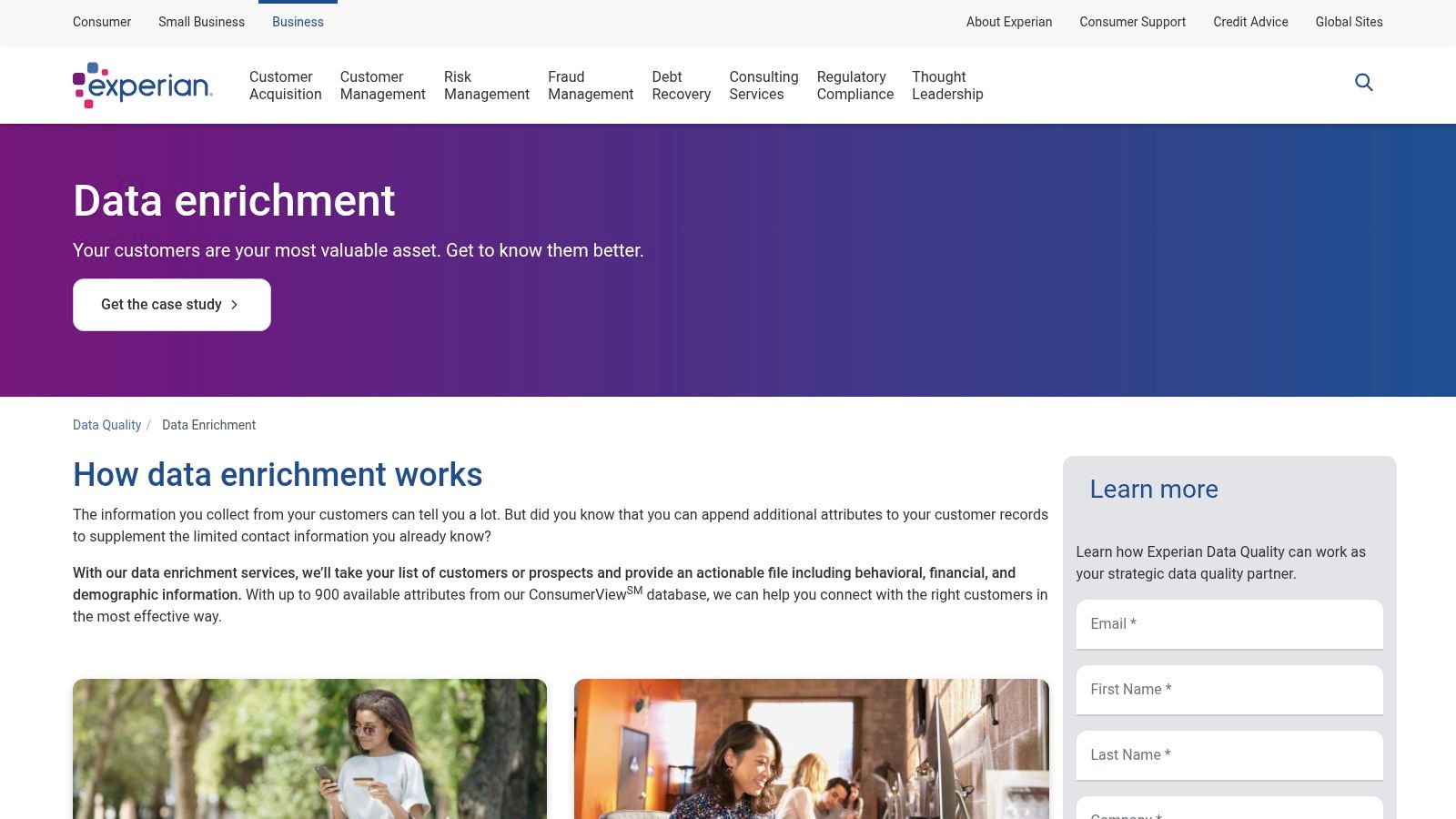
This tool is less of a self-serve API and more of a comprehensive data quality program. A practical example would be a national retail chain that wants to personalize its direct mail campaigns. They provide Experian with their customer database of names and addresses. Experian enriches this list by appending demographic data (household income, presence of children), psychographic data (hobbies, lifestyle interests), and property data (homeowner status). The marketing team can then create highly specific segments, sending high-end furniture catalogs only to homeowners with incomes over $150k, and back-to-school promotions to households with children.
Evaluation
- Data Freshness & Quality: ★★★★★ (5/5)
- As a major credit bureau, Experian's data quality is its core business. The data is rigorously sourced, validated, and updated, making it a gold standard for consumer information accuracy, particularly for U.S. consumer data.
- Pricing is entirely custom and requires consultation with a sales representative. The model is built for enterprise-level contracts and often involves bundled services, making it inaccessible for smaller businesses or teams needing a simple, pay-as-you-go API solution.
ProsConsUnparalleled consumer attribute coverage and data qualityCustom, sales-led pricing model with a high barrier to entryCombines data verification and enrichment in one platformHeavier implementation process; not a self-serve API toolProfessional services available for strategy and onboardingLess suited for B2B use cases compared to B2C consumer profilingStrong heritage in data governance and complianceSlower integration cycle compared to developer-first alternatives
Website: https://www.experian.com/data-quality/data-enrichment
10. Melissa (Personator, Personator Enrich, Address/Email/Phone tools)
Melissa is a long-standing authority in address verification and identity data, offering a suite of tools that blend validation with enrichment. Its core strength lies in its USPS CASS-certified address verification, which ensures postal data accuracy for logistics and compliance. However, its Personator and Personator Enrich products extend these capabilities, allowing teams to append missing phone numbers, email addresses, and demographic details to partial customer records, making it one of the most reliable data enrichment tools for consumer data hygiene.
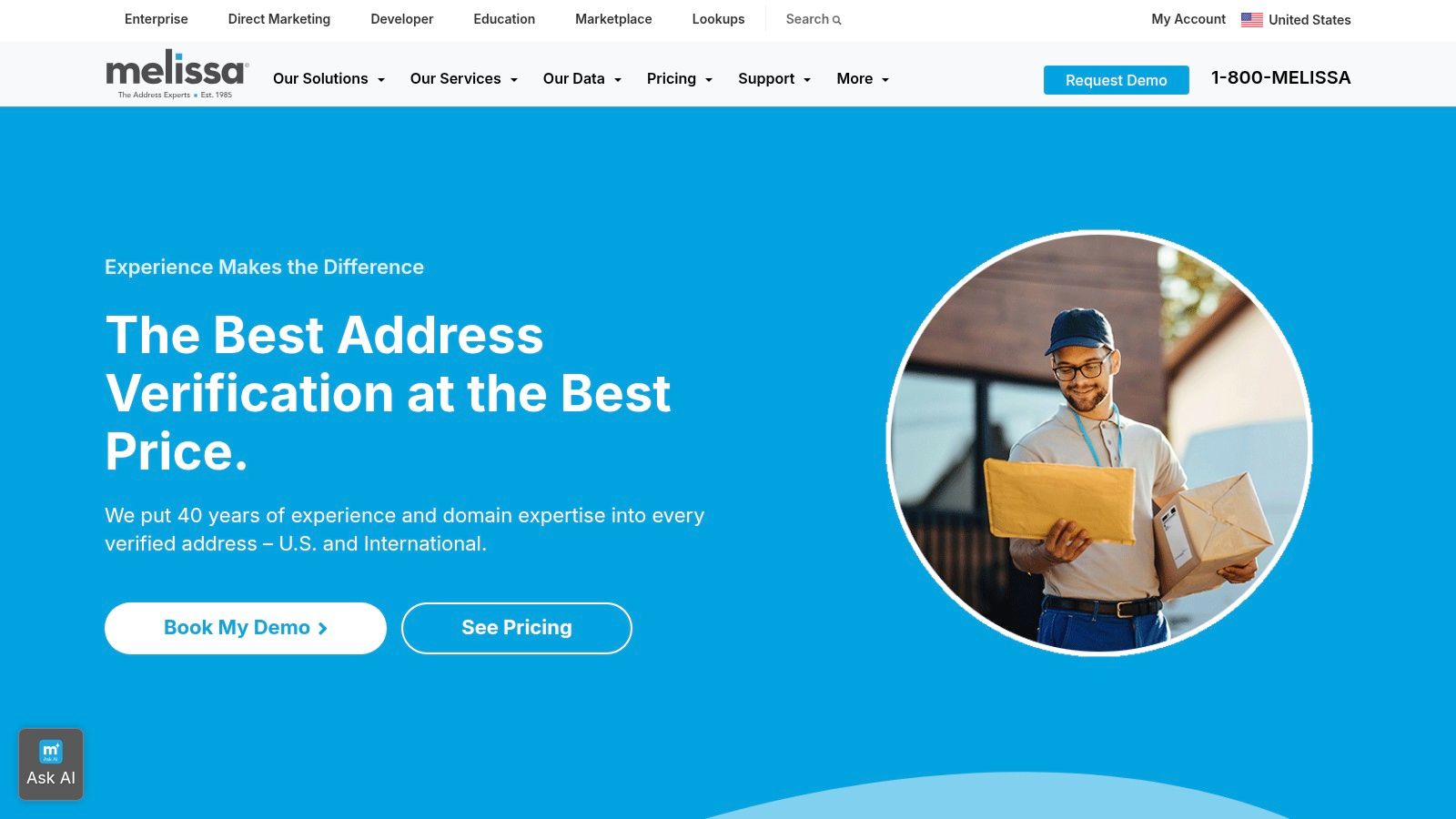
This platform is particularly useful for industries like e-commerce, healthcare, and finance, where accurate physical addresses and verified identities are non-negotiable. For example, an online retailer integrates Melissa's Address Verification API into their checkout page. When a customer types "123 Main St, New York," the API instantly suggests the standardized, USPS-approved version: "123 MAIN ST, NEW YORK NY 10001-1234." This corrects typos in real-time, reduces failed deliveries, and simultaneously enriches the customer profile with a verified phone number for SMS delivery notifications.
Evaluation
- Data Freshness & Quality: ★★★☆☆ (3/5)
- Excels in postal address and identity verification, leveraging authoritative sources like the USPS. However, its B2B firmographic and technographic data is less comprehensive compared to specialized B2B providers. The focus is primarily on contact and identity accuracy.
- Melissa offers highly transparent and flexible pricing. Teams can start with pay-as-you-go credit packs for smaller projects or move to annual subscriptions for higher volume and API access. This accessibility makes it a practical choice for businesses of all sizes needing to validate and enrich customer data without a long-term commitment.
ProsConsUSPS-certified address verification for high accuracyLimited B2B firmographic and technographic dataTransparent pricing with pay-as-you-go credit optionsSome advanced features are locked behind annual subscriptionsStrong for identity validation and consumer data enrichmentAPI documentation and developer experience can be less modernOffers both real-time API and batch processingPrimarily focused on North American data
Website: https://www.melissa.com/
11. AWS Data Exchange
AWS Data Exchange takes a different approach to data enrichment by acting as a centralized marketplace for third-party datasets and APIs. Instead of being a single data provider, it allows teams already operating within the Amazon Web Services ecosystem to discover, subscribe to, and ingest data from over 3,000 sources directly into their cloud infrastructure. This model is ideal for enriching large-scale analytics, machine learning models, or data warehousing projects.
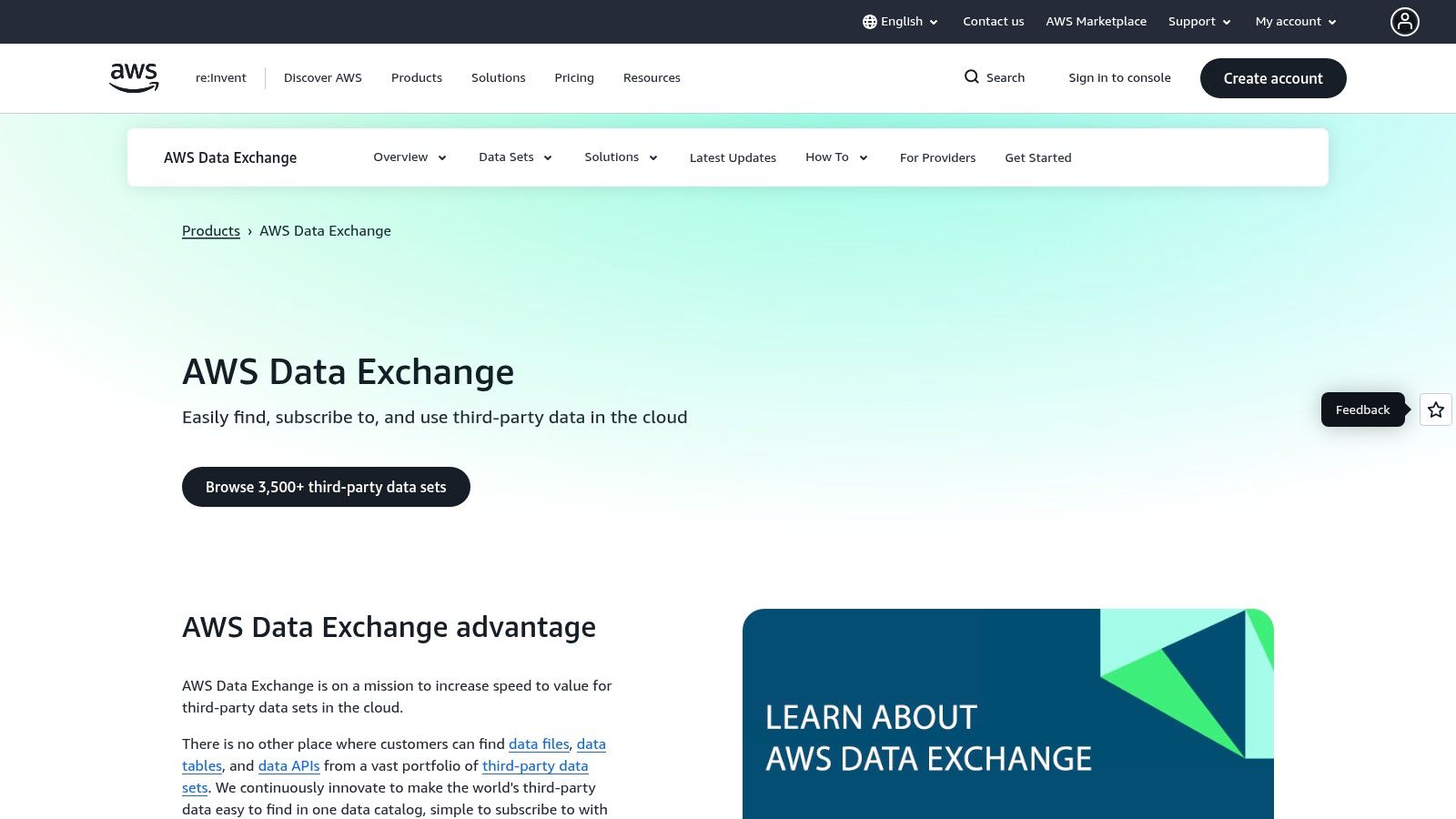
The platform's primary strength is its native integration with AWS services. Subscribed datasets can be delivered directly to an Amazon S3 bucket, making them immediately available for querying with services like Amazon Athena or for use in Amazon Redshift and SageMaker. For example, a data science team at an insurance company wants to build a risk model for coastal properties. They subscribe to a historical weather and flood risk dataset via AWS Data Exchange. The data is delivered directly to their S3 bucket, allowing them to join it with their existing customer property data in Amazon Redshift to enrich each property record with a "flood risk score," all without building a complex external ETL pipeline.
Evaluation
- Data Freshness & Quality: ★★★☆☆ (3/5)
- The quality and freshness are entirely dependent on the third-party data provider chosen from the marketplace. While many reputable providers are available, it requires diligence from the user to vet each source's update frequency and accuracy. The platform itself does not guarantee data quality; it only facilitates access.
- Pricing is highly variable, with each provider setting their own subscription terms, which can be a mix of free, one-time fees, or recurring charges. This lack of standardization requires careful comparison and can complicate budget management, although it does offer flexibility.
ProsConsMassive catalog of diverse third-party datasets and APIsData quality and pricing vary significantly between providersSeamless integration with the AWS cloud ecosystem (S3, Redshift)Requires an AWS account and familiarity with its servicesStreamlines data procurement, billing, and governanceNot a direct enrichment API; more of a data marketplaceIdeal for enriching large-scale analytics and ML pipelinesLess suitable for real-time, low-latency enrichment use cases
Website: https://aws.amazon.com/data-exchange/
12. Snowflake Marketplace
Snowflake Marketplace offers a unique, in-platform approach to data enrichment, allowing teams to acquire and integrate third-party datasets directly within their existing Snowflake environment. Rather than relying on external API calls, users can access live, ready-to-query data from hundreds of providers, significantly reducing data movement and simplifying governance. This model is ideal for large-scale, in-warehouse enrichment projects where data residency and security are paramount.
The core strength of the Marketplace is its "zero-copy" data sharing capability. For many listings, the data isn't physically moved into your account; instead, you are granted secure access to the provider's data where it lives. A practical example: an analyst at a CPG company wants to understand how local economic indicators affect sales. They access a public economic dataset on the Snowflake Marketplace. Using a simple SQL JOIN command, they can blend their own regional sales data with the third-party dataset on unemployment rates and consumer spending—all within their Snowflake worksheet. The results are available instantly for a Tableau dashboard, without ever needing to download, clean, or upload external files.
Evaluation
- Data Freshness & Quality: ★★★☆☆ (3/5)
- Quality and freshness are entirely dependent on the individual data provider chosen from the marketplace. While many reputable providers are present, the experience is not standardized. Users must vet each provider's update frequency and data sourcing methodologies, which can vary significantly from one listing to another.
- Pricing models are diverse, including free, subscription-based, and usage-based options set by each provider. A major consideration is that costs are twofold: you pay the provider's fee plus the cost of your own Snowflake compute credits used to query and process the data. This can make total cost less predictable than a fixed API plan.
ProsConsDrastically simplifies ETL and data integration workflowsRequires an existing Snowflake account and associated compute costsStrong governance and security, as data often stays in-platformData quality and freshness vary widely between providersAccess to a wide variety of datasets beyond typical B2B dataNot ideal for real-time, transactional enrichment (e.g., form fills)Ability to trial datasets before committing to a purchaseFinding the right dataset can require significant evaluation
Website: https://www.snowflake.com/marketplace/
Making the Right Choice for Your Data Strategy
Navigating the landscape of the best data enrichment tools can feel overwhelming, but making the right choice is a pivotal moment for your entire data strategy. We've explored a wide spectrum of solutions, from the enterprise-scale databases of ZoomInfo and Dun & Bradstreet to the sales-focused, all-in-one platforms like Apollo.io and Lusha. We've also looked at the raw data marketplaces of AWS and Snowflake, which offer immense flexibility but require significant engineering resources to operationalize.
Each tool offers a distinct approach. While traditional platforms provide a vast pool of static data, they often operate on a model of periodic updates. This means the information you pull today might have been accurate three months ago, a critical vulnerability in a fast-moving market where people change jobs and companies evolve constantly. For teams needing basic contact top-ups for a CRM, this might suffice. However, for those building sophisticated, real-time applications, this latency is a significant bottleneck.
The Decisive Factor: Real-Time vs. Cached Data
The most critical takeaway from our analysis is the fundamental difference between accessing a cached database and performing a live, real-time query. Your choice here dictates the very nature of what you can build and how competitive your operations can be.
- Cached Data (The Old Way): Think of this as pulling a report from a library archive. The data is comprehensive but fixed in time. A sales team using an all-in-one platform might enrich a list of 1,000 leads, only to find that 15% of the job titles are outdated, leading to wasted outreach and flawed segmentation.
- Real-Time Enrichment (The Modern Way): This is like having a live conversation. When you query an API from a tool like Limadata, it actively verifies information at that exact moment. For an AI SDR application, this means it can reference a prospect's very recent social media post or confirm their current role before initiating a conversation, making the outreach hyper-relevant and effective.
This distinction is no longer just a technical preference; it's a strategic imperative. For product managers and engineers building the next generation of AI agents, recruiting platforms, or dynamic personalization engines, relying on stale data is like building a race car and filling it with old fuel. The engine might be powerful, but its performance will be fundamentally compromised.
Actionable Steps for Choosing Your Tool
To move forward, avoid analysis paralysis by focusing on your primary use case. Define what success looks like and work backward to find the tool that enables it.
- Define Your Core Need: Are you simply filling gaps in your CRM (sales ops), or are you building a product that requires live, event-driven data (product/engineering)? If it's the latter, prioritize API-first solutions with webhook support.
- Run a Data Freshness Test: Don't just take a vendor's word for it. Take a sample list of 100 contacts you know have recently changed roles or companies. Run this list through the APIs of your top 2-3 contenders and compare the accuracy and freshness of the results. This simple test cuts through marketing claims and reveals the true quality of the underlying data source.
- Evaluate the Developer Experience: If you're building software, the quality of the API documentation, the simplicity of the integration, and the responsiveness of developer support are paramount. A powerful tool with a poor developer experience will create costly delays and long-term maintenance headaches.
Ultimately, selecting the best data enrichment tool is an investment in your organization's intelligence. By prioritizing real-time data, API flexibility, and a developer-centric mindset, you aren't just buying a data source; you are building a resilient, adaptive foundation for future growth and innovation.
Ready to see how real-time, live-verified data can transform your applications and workflows? Explore Limadata's developer-first APIs to build products that are not just data-rich, but truly intelligent and responsive. Get started with our comprehensive documentation and see why the best B2B sales and recruiting tools are built on Limadata.


.svg)